This blog is something I have been reflecting on for a long time and, in some ways, have avoided writing. I also discussed this blog with loved ones to gauge their perspectives, and was advised to prepare for potential backlash and its consequences. This is not an easy or comfortable position to be in, so I had to take some time to reflect carefully before making a decision. However, as a trauma therapist and a trauma-informed supervisor, I feel a strong duty of care to share this.
For any therapists reading this blog, I would urge you to approach it with an open mind and without defensiveness. Please know that this is not a judgement or a criticism of you as a person.
Eye Movement Desensitisation and Reprocessing (EMDR) is a highly recommended therapy for trauma and is recognised as evidence-based, including in NICE guidelines for PTSD. While I rarely use EMDR on its own, preferring to combine it with other trauma-informed approaches, I have completed all three levels of EMDR training through the EMDR Association, which is the official accrediting body in the UK and Europe. This means I am trained to deliver EMDR safely, effectively, and in a way that meets your individual needs, especially when working with complex trauma.
This might come as a shock to some, but in the UK, counselling and therapy titles are not protected, which means anyone can present themselves as a therapist and offer therapy, which is actually very scary! The good news is that the EMDR Association has very strict requirements for therapists to attend accredited training. You can only train in EMDR if you have a recognised mental health qualification, are currently providing one-to-one therapy, and are professionally accredited or registered with an approved body (for example, HCPC, BACP, UKCP, BABCP, or similar). Therapists also need several years of therapeutic/clinical experience, ongoing supervision, and access to clients during training. Supervision is recommended throughout standard EMDR training (Parts 1–3) to ensure skills are practiced safely, but for those working toward full EMDR accreditation, supervision must be provided by an EMDR-accredited supervisor and include a required number of supervised EMDR client sessions. These rules are in place to ensure that EMDR is delivered safely and responsibly.
It is important to know that these standards are specifically for EMDR training accredited in the UK and Europe. Other regions, like the United States, have their own recognised organisations, such as EMDRIA, which also require professional licensure, clinical experience, and completion of approved EMDR training. While the exact rules vary, the goal is the same everywhere: EMDR should only be offered by therapists who have received proper, accredited training. These standards exist because trauma work carries inherent risks when not approached with sufficient training, supervision, and ethical clarity.
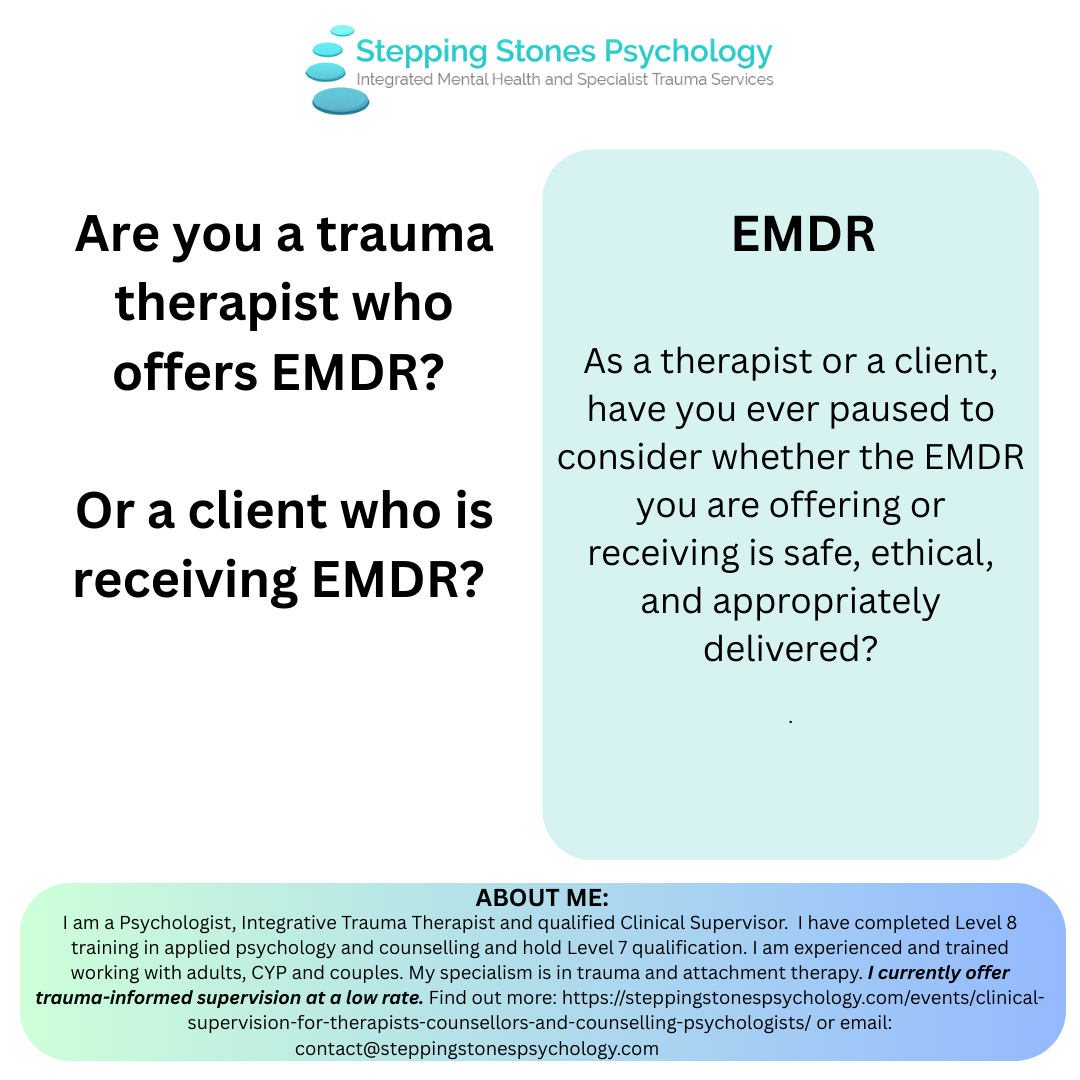
The issue I am concerned about and wanted to bring to attention is that many therapists offer EMDR, but not all have completed an EMDR accredited training (their training is not approved by the EMDR association). Some may have only done short workshops that are not formally recognised. EMDR is not only a powerful therapy, but usually offered to clients who have experienced trauma, so when delivered without proper training, it may not only be less effective but, in some cases, retraumatise the client.
I want to clarify that when I say proper training, I do not mean that therapists need to be EMDR-accredited (completed accreditation level of EMDR training). I am referring to standard EMDR training that is delivered by an EMDR-accredited training provider. Accreditation is a separate process in the UK, and you can practice EMDR safely, effectively and ethically once you have completed the standard training with an accredited provider, without needing full accreditation yourself. Equally, be cautious of some EMDR training being advertised using the word certified. This can be misleading in training contexts because it often simply means you receive a certificate of completion at the end, not that you are formally certified, accredited, or recognised by an official governing body.
So this blog is for vulnerable clients seeking trauma therapy, and for therapists wanting to practise ethically and safely. To do that, one needs to understand the difference between approved, accredited EMDR training and informal or non-approved training pathways.
Through this blog, my aim is to support informed choice, client safety, and ethical reflection, without blame or shaming, including towards the therapists who offer non-accredited EMDR. Trauma work is complex and carries significant risk. I have worked as a therapist for 20 years and have specialised as a trauma therapist for the past 10 years. I am still learning, and I certainly still get things wrong at times. Let’s break down the issues that concern me:
Client safety and risk of harm
Without accredited EMDR training, therapists may lack the skills required to assess readiness, stability, and also dissociation. They can end up moving too quickly into trauma processing without adequate preparation (Phase 1/stabilisation work). They might miss signs of when the client’s nervous system is going into overwhelm or shutdown, and they might also struggle to contain or repair ruptures when processing becomes destabilising.
If you are a client, when the above happens it means there can be an increase in the risk of emotional flooding, retraumatisation, dissociation, heightened symptoms between sessions and sadly also loss of trust in therapy. When EMDR is practised unsafely, clients may conclude that EMDR doesn’t work, is too intense or harmful, and that trauma therapy itself is unsafe. Unfortunately, this can then prevent clients from accessing competent trauma therapy in the future and it does a disservice to a modality with such a strong evidence base.
Often these outcomes are not a failure of EMDR itself, but of insufficient training, which can reflect as insufficient pacing of the sessions and containment of the client.
The nervous system and trauma complexity
Approved EMDR training includes in-depth education on the neurobiology of trauma, the window of tolerance, autonomic nervous system responses, including dissociation. Integrated EMDR also include parts work, attachment dynamics and relational safety.
Without this depth, EMDR risks being done in a more mechanical way rather than relationally. This is particularly important when working with clients who have experienced developmental trauma, attachment trauma, or complex PTSD, where pacing, resourcing, and attunement are even more critical.
Ethical transparency and informed consent
As clients you have a right to know the level and nature of the therapist’s training, understand what EMDR therapy involves and make informed choices about how they work. Give yourself permission to ask your potential therapist any questions you need, free from shame or guilt.
Using the title EMDR therapist without completing approved training can unintentionally mislead clients and undermine informed consent, even when there is no ill intent. There is a significant difference between using simply a set of techniques or the use of bilateral stimulation, and actually practising EMDR therapy, and I think it is very important both for clients and therapists to be understand the distinction.
Questions you can ask a therapist:
• Is your EMDR training EMDR Europe or EMDRIA approved?
• Where are you in your accreditation pathway?
• Do you receive EMDR-specific supervision?
• How do you assess readiness and safety before processing?
• How do you navigate dissociation and destabilisation?
• How do you navigate a situation where a client is having an abreaction (a strong emotional and physiological release during processing, where the client may vividly re-experience aspects of the trauma such as images, emotions, body sensations, impulses. It can look like an active flashback) or dissociative abreaction?
I appreciate that professionals in this field would know what all of this means, but as a client you might not know what some of these questions mean and what you suppose to be looking for in a response. Feel free to ask me if you are unsure, or if you like me to write a follow-up blog covering this, let me know and I will be happy to.
Why some therapists still choose non-accredited EMDR training
It is important to name that many therapists who complete non-approved EMDR trainings do not do so maliciously. From my observations and discussions, I have come to understand that there are some common contributing factors. Some of these are lack of awareness of accreditation standards, there is financial and accessibility barriers versus a high demand for trauma therapy. The latter which can also lead to professional pressure to offer EMDR, while at the same time also underestimate the clinical risks involved with trauma work. Then there is also the misleading marketing by training providers and finally the gaps when it comes to regulation and title protection.
Understanding these pressures allows us room for reflection rather than blame, while we can still prioritise ethical responsibility. Like I mentioned at the beginning of this blog, the aim of this blog is not judge, criticise or shame anyone, but instead of educating people, so everyone involved can make an informed decision.
Supervision and accountability
Accredited EMDR pathways require trauma/EMDR-specific supervision and consultation. This is not optional , but a recommendation because without this, therapists may practise outside their competence and they might end managing complex cases in isolation. Opportunities for learning and corrective feedback are obviously reduced as well, and the consequence of this could be that clients may be left carrying the impact of our clinical errors.
A trauma-Informed position
As a trauma-informed supervisor, my recommendation is that ethical trauma work requires knowing the limits of our competence as therapists, being transparent about our training and experience, ensuring we seek appropriate supervision, and being humble enough to refer clients on when needed. Above all, this means prioritising client safety over professional identity or demand.
I know some therapists argue that protecting EMDR training standards is about gatekeeping, but I don’t view it in this way. The more I have the honour and privilege of working with trauma, the more I genuinely believe that this work is about responsibility and respect, for trauma itself and for the vulnerable clients who place their trust in us.
Final thoughts
I hope this blog has been helpful. If you are a therapist who has been offering non-accredited EMDR, I hope you can be gentle and kind to yourself, especially if feelings of guilt, shame, or a critical inner voice are coming up. It is important to be compassionate and non-judgemental towards yourself, in the same way we encourage our clients to be with themselves.
We have all been there. I have certainly made therapy choices that were not the best and have had to learn from my mistakes, supported by good supervision, and I am still learning.
©Sharmi under Stepping Stones Psychology – All Rights Reserved 2026
—
Monthly Trauma-Informed Support Groups: https://steppingstonespsychology.com/events/monthly-trauma-informed-support-self-care-circles/
Trauma-Informed Supervision: https://steppingstonespsychology.com/events/clinical-supervision-for-therapists-counsellors-and-counselling-psychologists/