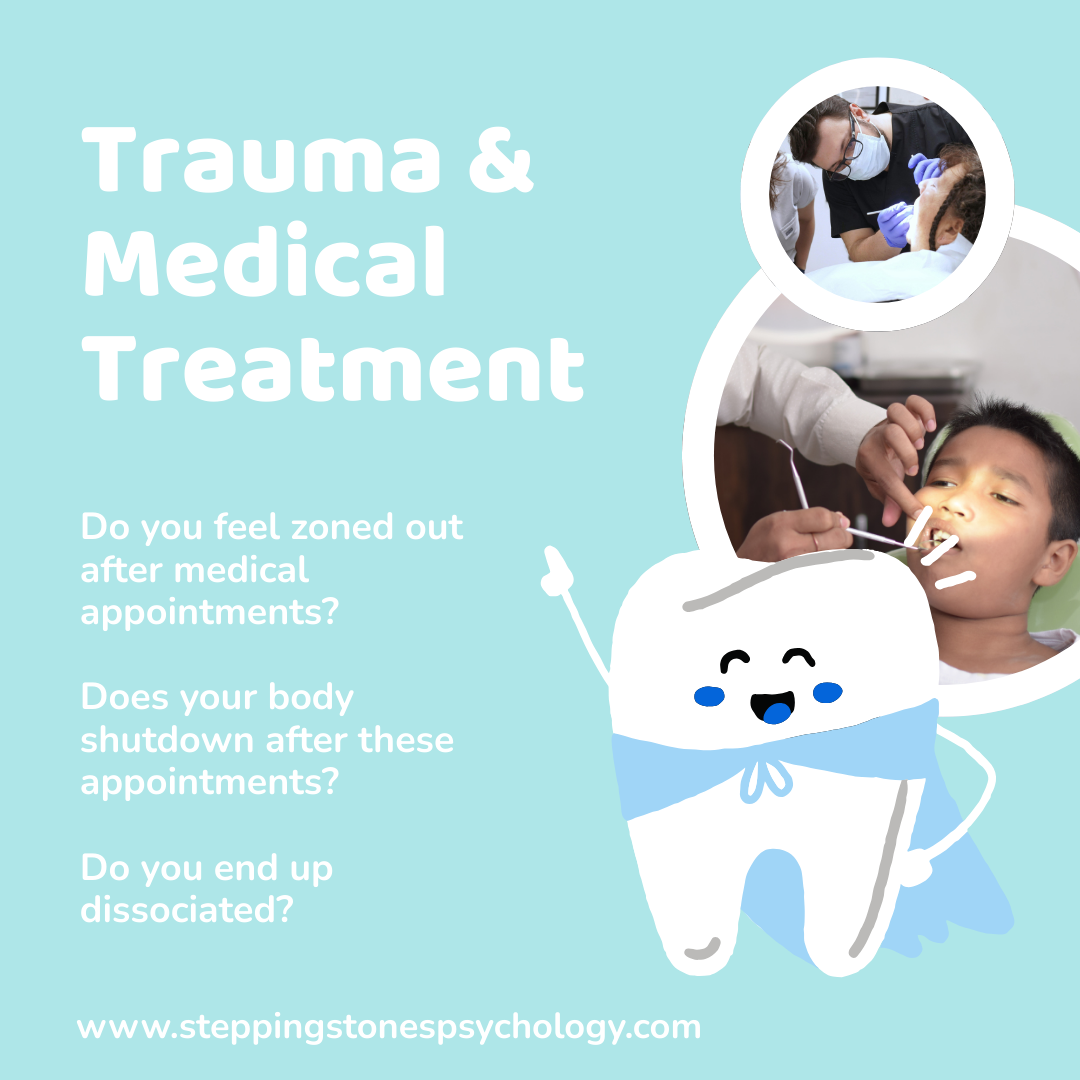
So I had a dentist appointment last weekend, and it did make me wonder how numbed and zoned out I always felt throughout the day after every dentist appointment. I wondered whether it had any link to Post-Traumatic Stress Disorder (PTSD). Now, although I know that a lot of people suffer from phobia and anxiety when it comes to dentist visits, I suffer from neither of those, so this is what made me curious and reflective of why my body always had this extreme reaction. The more I reflected on it, the more I realised that this might be a common issue for other people who have experienced trauma and may/may not also navigate PTSD. So that is why I decided to write a blog on this topic, in case it could be helpful for others.
I think it makes sense that people with past trauma, even when their trauma has nothing to do with dentistry, can often struggle with dental appointments because the experience can unintentionally trigger our body’s trauma response. This is especially common in people with PTSD, but it can also happen in those without a formal diagnosis. From my years working in the field of trauma, my understanding is that one of the reasons is the loss of control, as trauma obviously often involves helplessness or lack of control. If you really think about it, at the dentist you are lying on your back, and someone is in your personal space. You can’t easily speak and might also feel physically vulnerable, so for someone with a trauma history, this setup can unconsciously mirror our past experiences. This in return then activates our fight-flight-freeze response, so where for some people this might be feeling panicky and anxious, in my case, it is more of a freeze response.
Most of us hopefully have a dentist who we feel safe with, but that is more of a logical, rational knowledge, whereas the physical positioning and power dynamics involved, such as being reclined and having someone stand over you, can remind our body of past situations where we felt trapped or overpowered. Our brain reacts to patterns and not logic, so even when the situation is safe, the nervous system may interpret it as a threat. Like Bessel van der Kolk often explains, trauma memory does not return as a clear visual story, but instead shows up as reactions, sensations, emotions and impulses, so when we are triggered, it is not always a case of remembering the trauma itself, but our body re-experiencing it.
Having instruments in our mouth can create gag reflex, feeling of choking, fear of not being able to breathe, so again, for someone with past trauma involving restraint, assault, suffocation or panic episodes, this can be especially triggering.
For some people, it could also be a case of sensory triggers, as dental environments are highly sensory, with those horrendous loud high-pitched drills, smells of the antiseptics, vibrations, water pooling in our mouth, gloved hands in our mouth etc. Trauma survivors often have heightened sensory sensitivity, and having PTSD is considered a form of acquired neurodivergence as well. So on top of the sensory overload that comes with being neurodivergent, there is the fact that certain sounds, smells, or body sensations can trigger flashbacks or panic.
When there has been a history of trauma, especially chronic trauma, hypervigilance is usually also present. PTSD often includes constant scanning for danger, so if you really think about it, when we are in a dental chair, we can’t see what’s happening, but you hear unfamiliar sounds and feel unpredictable sensations, so again, it is the unpredictability which is usually a huge factor. That uncertainty can increase anxiety significantly, but for most trauma survivors, it can trigger a heightened fear response.
People often downplay this, like I mentioned earlier, thinking it is ‘just’ a dentist appointment, no real danger, etc., but we know now that our body memory is real. Trauma is not only remembered cognitively, but it is stored somatically (in our body). Even if a person consciously knows they are safe, their nervous system may react automatically. You might end up crying without knowing why, dissociate (spacing out), having panic attacks, and sometimes just a sudden urge to leave.
So it is not overreacting and people often end up being judgemental towards themselves, thinking their reaction shows weakness or immaturity, or even others could have these beliefs or make comments about you expressing this. In reality, it is just our nervous system trying to protect us, based on what it has learned from past survival. Our body basically says this feels similar to past danger and shouts out to activate maximum protection-mode! This happens even when your mind says things like, this is just cleaning.
If you are not panicking, but you feel tense during the appointment and then suddenly floaty or disoriented, your nervous system may be going into a mild freeze response (I think this is what happened in my case). This is very common in trauma survivors, where the process is not a case of first feeling calm, then panicked and ending up dissociating. Instead it is usually much quieter than that, where it is more like you start feeling tense, then your body braces and holds everything in, and then it gently shifts into a subtle shutdown.
So in this case, there is not always a big wave of panic. Sometimes your nervous system just moves from holding it together into a mild protective freeze without you even realising it. In the dental chair, your body may quietly shift into ‘just endure this’ mode. You might notice that you start to tighten your muscles, your breathing becomes shallow (I always feel like I forget to breathe!), staying very still, focusing hard on getting through it. I remember in a training I attended ages ago, the trainer explained that if we hold that braced state for 30–60 minutes, our nervous system can shift into a protective buffer, which shows up as that floaty, foggy, slightly unreal feeling (Hands down, I am guilty of this)! In this case, you are not exactly emotionally overwhelmed, but physically over-activated while suppressing it, and this is, understandably, very exhausting.
In my case following this freeze response, my body drops out of the brace mode once my appointment ends. So that drop can feel heavy and drained, and it makes me think of how it must be to hold a plank for an hour, except emotionally and physically. Of course, you feel tired afterward as your nervous system worked hard to hold everything together.
So going back to my last dentist appointment, I went into dissociation, which is, like I explained above, when our nervous system’s freeze or shut down survival response switches on. It usually comes on when fight (struggle) or flight (escape) don’t feel possible, and the brain then switches to dissociation instead. Dissociation is a spectrum, so it is not all the same. For example, there is spacing out, feeling detached from your body, emotional numbness, time distortion, feeling like it is happening to someone else.
My aim with this blog is to offer acknowledgement, compassion and empathy to you if you have experienced something similar and was maybe confused and wondered why you had such a strong reaction to medical appointments. I hope this blog has been helpful.
So if dental appointments leave you feeling numb, foggy or unsettled, you are not alone in that and please know that your reaction makes sense. Please know that you are not being dramatic, weak or overreacting but that your nervous system is doing exactly what it learned to do to keep you safe. It is responding from memory and not from a place of weakness or failure, so there is nothing shameful about. Your body is just protecting you in the only way it knows how, so it deserves compassion and empathy, not judgement or criticism. At the same time, I also want you to know that with continued awareness, that response can slowly become less intense. I hope you know that you deserve kindness and compassion while your body/nervous system learns that it is safe.
This is an excellent resource you can give your dentist. There are loads of other helpful resources here, including a whole section dedicated especially to medical resources, the latter which could be very helpful if you are due to have a medical procedure or blood tests/injection, or sexual health checks etc. (there is a separate PDF for each of these, and for several other topics)
©Sharmi under Stepping Stones Psychology – All Rights Reserved 2026