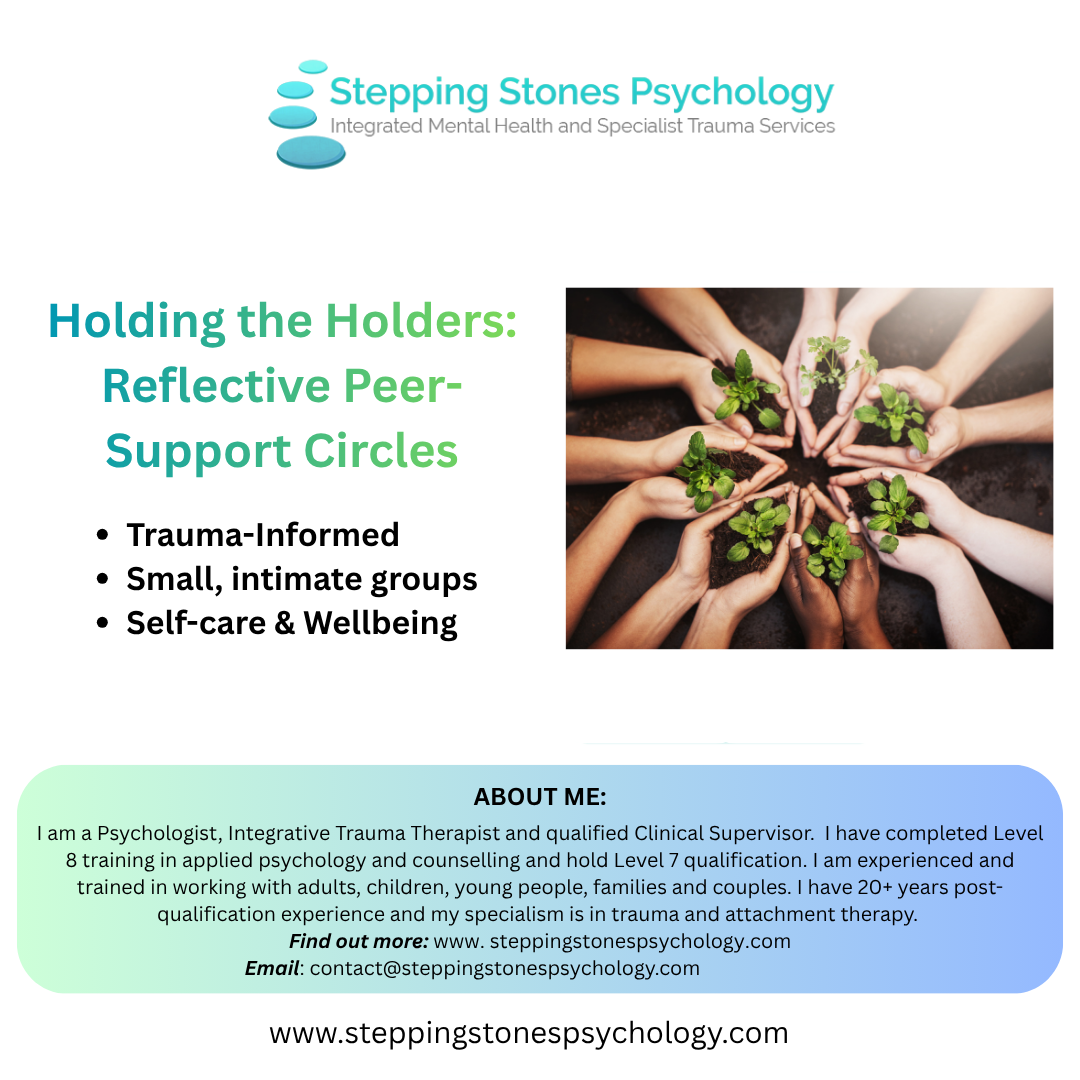
An annual trauma-informed reflective space for therapists and professionals working with trauma
Are you feeling emotionally drained after work? Do you find yourself carrying the emotional weight of the people you support, even after the working day has ended?
Holding emotional, complex or trauma-related client work can take a toll on us, even when we are deeply passionate about what we do. I believe this is an aspect of our work that we don’t talk about enough, and one that deserves dedicated attention.
As someone who values end-of-year reflection in both my personal and professional life, I have created the annual Reflect & Reset Circle, which is a trauma-informed reflective space for therapists, coaches and other mental health professionals, with the intention of pausing, integrating and closing the year with greater awareness and self-care.
This is not regular clinical supervision or a traditional consultation group, but instead a unique, supervision-informed reflective gathering, designed specifically to give you time and space to reflect on your own experiences of holding space for others.
As a Specialist Trauma Therapist, I have created a safe and collaborative small-group space that invites you to take an embodied pause. Drawing on my background as a supervisor and trainer in burnout, compassion fatigue, and vicarious trauma, I designed this space specifically to support you through the unique challenges of your work.
WHY THIS SPACE?
I personally understand how much we can carry when holding space for trauma. Even with good supervision in place, much of what we hold can stay with us, because supervision is often primarily focused on our clients and clinical practice, rather than carving out dedicated time for our own emotional processing, reflection and self-care.
This can leave us managing the cumulative effects of emotionally demanding work, including secondary stress, secondary trauma, vicarious trauma and compassion fatigue.
Despite being passionate about what we do, these experiences can affect our emotional wellbeing, capacity and ability to remain present and attuned in our work. Supervision is important, but it does not always provide the dedicated space needed to attend to our own needs as practitioners. This is why I created Reflect & Reset. A space to step away from the demands of our professional roles, pause, reflect and reconnect with ourselves. An opportunity to acknowledge what we have been holding, recognise what we might need to put down, and consider how we want to move forward.
WHAT WILL WE EXPLORE?
The gathering will offer a blend of reflective and restorative practices, including:
- Trauma-informed guided reflection, with opportunities to explore and integrate the year’s professional experiences.
- Gentle nervous-system regulation practices to support grounding and emotional wellbeing.
- Embodied reflection, including opportunities to deepen somatic awareness.
- Exploring the emotional impact of working with trauma, distress and high emotional demand.
- Reflecting on self-care, compassion and resilience when supporting others.
- Recognising the signs of burnout, compassion fatigue, secondary stress and vicarious trauma.
- Exploring healthy professional boundaries, including recognising when to step back, slow down or say no.
- Considering how we can continue to sustain ourselves and our work without losing sight of our own needs.
The intention is to offer a restorative opportunity to release, integrate and make sense of some of what you have been holding, so that you can step into the new year feeling more grounded, clear and resourced.
THE AIM
Reflect & Reset aims to:
- Provide a dedicated space for reflective practice for professionals working with trauma and emotional distress.
- Support professional wellbeing, emotional capacity and resilience.
- Reduce the risk of cumulative stress and vicarious trauma.
- Encourage ethical, sustainable and trauma-informed practice.
- Create opportunities for self-reflection without any expectation of personal disclosure.
- Support practitioners in reconnecting with their own needs while continuing to care for others.
WHO IS THIS FOR?
This gathering is particularly suited to:
- Psychologists, counsellors and psychotherapists.
- Coaches and mental health professionals.
- Social workers and other professionals working directly or indirectly with trauma.
- Practitioners who regularly hold space for people experiencing distress, adversity or complex emotional difficulties.
- Professionals seeking a reflective space that complements, rather than replaces, their existing supervision arrangements.
- Those who would value an opportunity to pause, reset and reconnect with themselves at the end of the year.
If you are a therapist, you may already have supervision, consultation groups, CPD commitments and a busy caseload. This gathering is not intended to add another professional obligation or replicate what you already have in place. While those spaces are important, this is an opportunity to turn some of that attention towards yourself.
FORMAT & STRUCTURE
- Format: Online via Zoom.
- Group size: Small, contained group of a maximum of 6-8 participants.
- Duration: 2 hours with breaks.
- Approach: Trauma-informed, choice-led and collaborative.
- Cost: £60 per session, however reduced rates are available for those facing financial hardship
- Date: Several dates across December
The sessions will be gently facilitated, with an emphasis on psychological safety, reflection and personal choice. There is no expectation to disclose personal material or share anything you do not feel comfortable sharing.
The space will incorporate guided reflection, gentle nervous-system regulation and opportunities to integrate clinical, therapeutic, relational and emotional experiences.
—
ABOUT THE FACILITATOR
My name is Sharmi, and I am a psychologist, a full member of the British Psychological Society (BPS) and the Founder and Clinical Director of Stepping Stones Psychology, an integrated mental health and specialist trauma therapy service.
I am also an Accredited Professional Registrant (PNCPS Acc.) of the National Counselling & Psychotherapy Society (NCPS) as a psychotherapist, and hold a BPS-accredited Level 3 Supervision qualification.
In my therapy work, I use an integrative approach rooted in humanistic values, particularly person-centred principles. My supervision and facilitation style is warm, relational and grounded in a strong ethical foundation, with a particular focus on self-care, resilience and practitioner wellbeing, reflecting my specialism in trauma recovery work.
I draw on psychodynamic, humanistic and somatic approaches, always through a trauma-informed and attachment-based lens. I also utilise the 7-Eyed Supervision Model to support reflective practice.
I uphold high professional standards, having completed doctoral-level education and training in Counselling Psychology. I also bring specialist expertise from my previous role as a Specialist Trauma and Attachment Therapist at a dedicated trauma therapy centre.
Through my clinical and supervision work, I recognise the importance of creating spaces where professionals can feel supported, reflected and resourced, particularly when working with the cumulative emotional impact of trauma. Having led numerous therapeutic and peer circles over my 20+ year career, I offer a contained, non-judgmental space rooted in nervous system regulation, where you are gently guided to share and process at your own pace
INTERESTED IN JOINING?
If you would like to attend the annual Reflect & Reset Circle or have any questions, please get in touch via contact@steppingstonespsychology.com
Please note: the email address is steppingstones (plural), not steppingstone.
© Sharmi | Stepping Stones Psychology – Integrated Mental Health & Specialist Trauma Therapy Services ® – All Rights Reserved 2026


