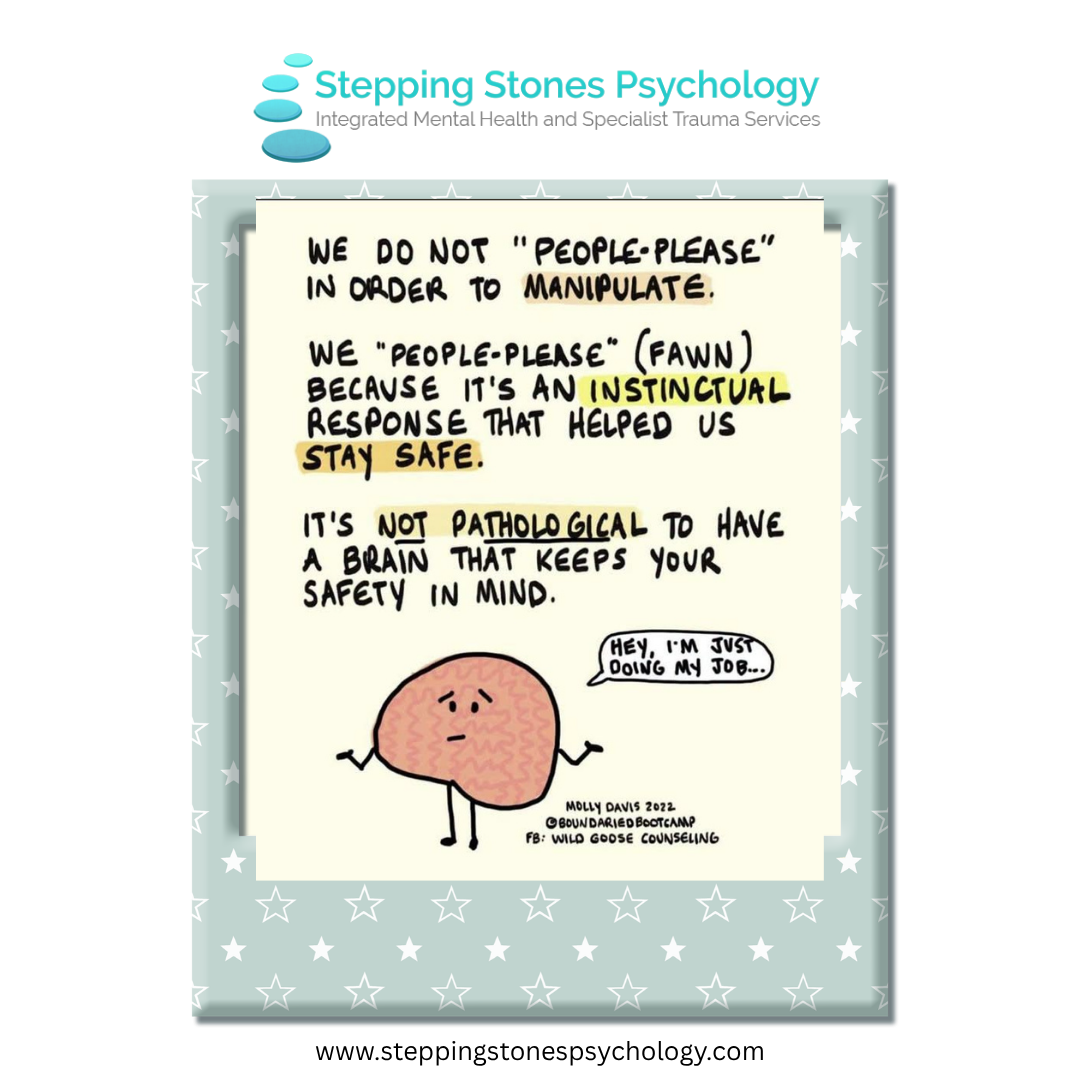
If you have experienced relationship-related trauma (known as interpersonal trauma, or attachment trauma when it stems from your relationship with your parents), then in tricky situations or when triggered, you might go into fawn mode.
The fawn response is a survival pattern that can look like people-pleasing, appeasing others and self-abandonment. For example, people-pleasing is saying yes when you want to say no or putting other people’s needs before your own to gain approval or avoid disapproval, whereas appeasing others could mean trying to stay calm, keep happy or avoid upsetting someone because their reactions feel threatening or unsafe. Self-abandonment comes up quite a lot too, which is ignoring your own feelings, needs or boundaries to keep the peace or avoid conflict.
Although people-pleasing and appeasing overlap, they are actually not exactly the same. People-pleasing is a broader pattern of seeking approval and avoiding disapproval, whereas appeasing is more specifically about trying to keep someone calm or satisfied because their reactions feel unsafe or unpredictable. In trauma, appeasing often better describes the fawn response because it is about trying to stay safe, rather than simply wanting to be liked.
Resources (books, videos and podcast)
Here are some resources that are most consistently recommended by trauma clinicians and people recovering from complex trauma. If this applies to you, you might find these helpful:
When people ask me for recommendation, I usually always start with Pete Walker’s Complex PTSD: From Surviving to Thriving, as this is probably the best place to start if you are learning about the fawn response. Pete Walker was one of the first people to write extensively about it and he explains why fawning develops, how it is different from simply being a kind or caring person and he offers practical ideas for recovery.
Then there is the ‘Bible’ of trauma books, which is The Body Keeps the Score by Bessel van der Kolk. Although this one isn’t specifically about the fawn response, I do usually recommend it as another introductory resource too because it does an excellent job of explaining how trauma affects our brain, body, nervous system and relationships. Lot of people really find it helpful for understanding the why behind trauma responses.
Other books that are great too once you have read he introductory ones are Healing the Fragmented Selves of Trauma Survivors by Janina Fisher. This is both a compassionate and practical book that helps you understand the different protective parts of yourself, including the part that fawns.
The Complex PTSD Workbook by Arielle Schwartz is another practical book, but it is great workbook with exercises to help you build healthier boundaries, regulate your nervous system, work through shame and develop more self-compassion.
If your fawning developed because of childhood emotional neglect, rather than more obvious forms of abuse, then the book called Running on Empty by Jonice Webb can be especially helpful. Jonice Webb is an expert in the work around the trauma resulting from emotional neglect.
Articles worth reading as well if you like to understand fawn response without committing to reading a whole book:
- Psych Central has one of the clearest introductions to the fawn response, including common signs, why it develops and ideas for recovery: here
- RAINN explains the fight, flight, freeze, and fawn responses in a simple easy-to-understand way: here
- Psychology Today: here
If you prefer podcasts or videos, you can also search YouTube or your favourite podcast platform for interviews with:
- Janina Fisher
- Gabor Maté
- Arielle Schwartz
- Bessel van der Kolk
- Pete Walker
They all talk about trauma, attachment, the nervous system, boundaries and protective survival responses in ways that can help make sense of the fawn response.
Online communities and other resources
My top favourite online community is the CPTSD Foundation, they have a website and also social media pages. Other than that, if you find it helpful to hear from people with lived experience, CPTSD communities can be a useful source of support and shared understanding. One thing you’ll notice is that Pete Walker’s work is recommended again and again as the best introduction to the fawn response.
Many people also find that books about childhood emotional neglect, boundaries, assertiveness and self-esteem are just as helpful as resources that focus specifically on people-pleasing or fawning. My favourite books to recommend on boundaries is the work by Nedra Tawwab and also Boundaries: Where You end and I begin by Anne Katherine. I always very confident recommending Nedra’s work as she is a therapist who specialises in boundaries work. If I had to narrow down her books, these are the usual three I recommend to clients:
- Set Boundaries, Find Peace: This is a great starting point if you’re learning how to set healthy boundaries. It explains what boundaries are, why they can feel difficult and gives practical examples of how to communicate them in everyday relationships.
- Drama Free: This one focuses specifically on navigating difficult family relationships. Helpful if you struggle with family dynamics, guilt or knowing how to protect your wellbeing while maintaining (or redefining) family connections. For clients who come from dysfunctional and toxic family background, I do recommend this one in particular.
- The Set Boundaries Workbook is a wonderful practical companion to her Set Boundaries, Find Peace book, with reflective exercises to help you identify your own boundaries, communicate them more confidently, and put what you’ve learned into practice.
If you’re not sure where to start, I would recommend reading them in this order:
- Complex PTSD: From Surviving to Thriving
- Healing the Fragmented Selves of Trauma Survivors
- The Complex PTSD Workbook
- The body keeps the score
- Then the other resources
This order helps you first understand what the fawn response is and why it develops, before moving on to practical strategies for healing and a broader understanding of trauma.
If you recognise yourself in any of this, remember that the fawn response is not a personality flaw or a sign of weakness, but a survival strategy that developed for a reason. At some point in your life, it likely helped you feel safer, more accepted or protected. The fact that it no longer serves you doesn’t mean it was never useful.
Healing isn’t about becoming less kind or caring but about learning that your needs, feelings and boundaries matter too, and that you don’t have to abandon yourself to feel safe in relationships.
When do you notice yourself automatically putting someone else’s needs, feelings or comfort before your own, and what do you imagine might happen if you didn’t?
P.S
If you have read a book or another resource that really helped you understand the fawn response, people-pleasing or boundaries and it hasn’t been mentioned here, I would love to hear about it. Feel free to share it in the comments or send it to me privately.
The same goes for fellow therapists, if you have other books or resources that you have found particularly helpful with clients, please do share them. It is always great to learn from each other and build a broader collection of helpful resources.
Thank you 🙂
~ Sharmi
©Sharmi under Stepping Stones Psychology – Integrated Mental Health & Specialist Trauma Therapy Services ® ~ All Rights Reserved 2026
Image Credit: Molly Davis 2022, Boundaries Bootcamp and Wild Goose Counselling