As someone who primarily works with clients who have experienced trauma, I also support a large number of clients who identify as, or are exploring whether they might be, neurodivergent.
Clients often ask me about labels such as ADHD or autism, and whether I think they might have them. I explain that I am not a medical doctor or psychiatrist, so I am not able to diagnose. However, I am always happy to explore these questions with my clients and think together about what their experiences might mean to them.
My training is in counselling psychology, and at its core I use a humanistic approach. Some approaches in this field can be quite strongly against labels and diagnoses, but personally, I take a more flexible view. After all, a key principle of the humanistic approach is being client-centred, so for me, what matters most to me is how the client understands the label and what it means to them.
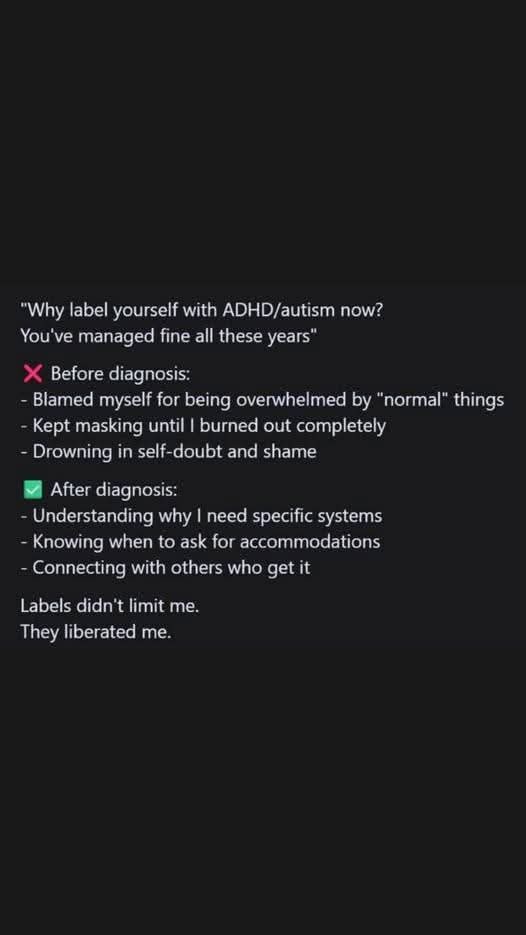
For some people, having a label like ADHD or autism can feel validating and helpful, so it can bring a sense of understanding, relief and sense of community. For others, it may not feel helpful and might even feel limiting, so there is no right or wrong here, but what matters is whether it supports the client really.
Here is a section from my website about labels and diagnoses, and how I work:
We work with a wide range of experiences that are often described using terms like PTSD, CPTSD, ADHD, Autism, and other forms of neurodivergence and trauma. For many people, these labels can offer clarity and a sense of validation, and we completely respect that. If these terms feel meaningful or helpful to you, we will use them in a way that supports your process.
At the same time, we take a non-pathologising approach to therapy. We don’t see your struggles as disorders or deficits, but as understandable responses to what you have lived through. We tend to avoid language like ‘disorder’ because it can sometimes feel limiting or carry stigma, and we believe it’s more helpful to view things in context.
This perspective is also part of how we work in a trauma-informed and trauma-sensitive way. We aim to understand ‘what has happened to you’, not ‘what’s wrong’ with you. Reactions that might seem overwhelming, confusing, or unwanted, such as anxiety, shutdown, emotional reactivity, or masking, are often protective responses shaped by past experiences. Basically, they are survival strategies rather than symptoms or problems to be fixed. They are ways your mind and body learned to cope. They make sense once we understand where they come from.
That said, you are the expert in your own life. If a particular diagnosis or label feels empowering for you and helps you feel seen, understood and validated, we will always honour and work with that language. Our aim is to meet you where you are, using a framework that supports both healing and autonomy, as therapy should always reflect your reality, not just ours.
I have been specialising in trauma for nearly 20 years, including doctoral-level research in this area and previous work as a specialist trauma and attachment therapist at a dedicated trauma and attachment centre One thing I have seen consistently, both in practice and in research, is that acquired neurodivergence as a result of early trauma is very common.
This is not just my opinion, but a perspective broadly consistent with research in psychology and neuroscience, including well-established findings on trauma, attachment and executive functioning (EF).
Research, including the well-known Adverse Childhood Experiences (ACE) Study, shows that trauma and early relationships can affect what we call executive functioning, which include skills like attention, emotional regulation, impulse control and planning. These are also the areas often associated with ADHD and similar experiences.
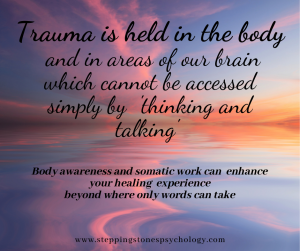
We also know from neuroscience that trauma can affect parts of the brain involved in regulation and stress responses. For example, trauma affects the prefrontal cortex, which is central to executive functioning, as well as the brain’s stress-response systems, which then affects emotional regulation and control. Work by Bruce Perry and Bessel van der Kolk also demonstrates how chronic childhood stress can alter brain development, so overall, the evidence shows that trauma and disrupted attachment are strongly linked to executive functioning difficulties. These difficulties are rooted in brain development and can continue throughout our lives.
This means that for some people, experiences that look like neurodivergence may also be connected to early trauma. The great part is that while neurodivergence itself is not something to be fixed, some of the ways the brain responds to stress and threat can change through therapy. I absolutely love the research on neuroplasticity and this hopefully quote sums up its power beautifully:
Trauma changes the brain, but healing changes the brain, too. By Dr. Sufna John
When the brain has experienced trauma and the trauma is unprocessed, the brain is often driven by the amygdala and threat-response systems. In other words, it can become focused on survival, meaning it has been constantly scanning for danger. This can make it much harder to engage the prefrontal cortex for thinking, planning and regulating behaviour, so it makes it difficult to think clearly, stay organised and even regulate emotions.
As the trauma is processed and the nervous system begins to feel safer, the brain spends less time focused on survival and instead starts to have more capacity for thinking, learning and organisation. This is why many people find they have more capacity for thinking, learning and managing everyday life once they are doing trauma therapy.
This is why improvements are often seen in executive functioning, so for this reason I believe it can be really helpful to offer psychoeducation to trauma survivors about how these processes may relate to challenges often associated with neurodivergent conditions.
During my time working at a specialist trauma and attachment centre with some of the country’s most traumatised children and young people, we often saw improvements in these areas, including executive functioning issues, though pre- and post-therapy BRIEF assessments.
I just want to make it clear that this does not mean that someone stops being neurodivergent. Rather, it can mean that their nervous system is less overwhelmed, and they have more access to their strengths and abilities.
Alongside working with trauma therapy with adults, I am also trained and experienced in working with children, young people and families who have experienced trauma. This was the focus of my full-time work at Chrysalis, and I continue to offer this in my private practice, including DDP (Levels 1 and 2) and Theraplay, both which are trauma-informed and attachment-based therapy models.
I hope this blog has been helpful to you. Please feel free to get in touch if you have any questions. I am most active on via my Facebook page, which you find here.
~ Sharmi
©Sharmi under Stepping Stones Psychology – All Rights Reserved 2026
Image source: Unknown