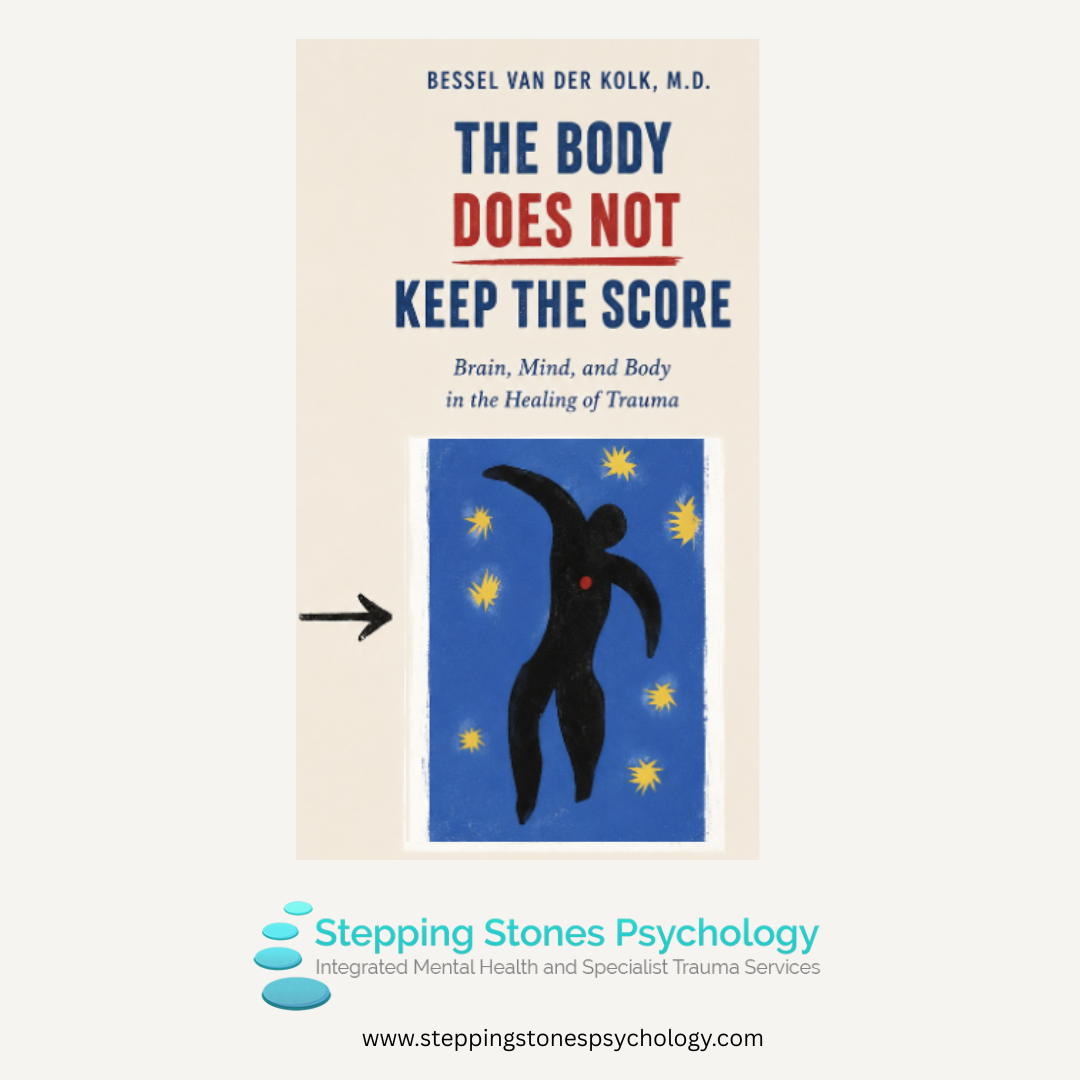
Many of you may have seen social media posts or articles claiming that Bessel van der Kolk’s work, particularly The Body Keeps the Score, has been disproven by recent research. Some influencers and therapist-influencers have gone even further, suggesting that this means somatic therapy is not a valid therapeutic approach.
Understandably, some of my clients have asked me about these claims and their questions prompted me to write about the topic and offer some clarification on what the research actually says, as well as what it does, and does not, mean for somatic therapy.
One of the key messages of The Body Keeps the Score is that trauma is not simply a memory or a thought, but instead that it can affect how we experience our bodies. For example, it influence our breathing, heart rate, muscle tension, energy levels, sense of safety and stress responses ect. I think many trauma survivors finally felt that their trauma responses started to make sense after reading his book, The Body Keeps the Score.
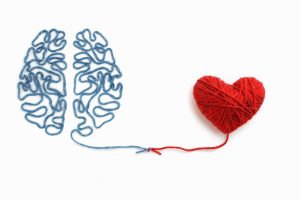
A recently published paper in Frontiers in Systems Neuroscience argues that trauma is not literally stored in muscles, organs or tissues in the way that some popular interpretations have suggested, as though it were a file stored on a hard drive. Instead, the authors suggest that trauma is mainly reflected in patterns within the brain and nervous system that shape how we anticipate and respond to danger. In other words, the paper is not saying that trauma is not present in the body, but rather questions whether trauma is stored in the body in the literal sense that some people have assumed.
What we do know is that after a traumatic experience, the nervous system can become stuck on high alert, continuing to respond as though a threat is present even when we are safe. This can lead to symptoms such as anxiety, tension, panic, hypervigilance and difficulty relaxing. These physical reactions can then reinforce the brain’s sense that danger is still present, creating a cycle that can be difficult to break. So while the body is deeply involved in trauma, it may be more accurate to think of it as an active participant in the process rather than a storage container for traumatic memories.
The main point I like to clarify is that the authors are not saying that somatic (body-based) therapies do not work. In fact, they suggest that many effective trauma treatments, including movement, mindfulness, EMDR, exercise, creative activities, and body-based approaches, may help because they support the nervous system in becoming more flexible and less stuck in survival mode. So the debate is not really about whether trauma affects the body as there is clear evidence that it does! The debate is about how trauma affects the body and how we understand the relationship between the brain, nervous system and physical experience. Trauma may not be literally stored in the body, but it absolutely influences how the body and nervous system experience safety, danger and the world around us. To me, that remains very much in line with the broader message of Van der Kolk’s work.
For trauma survivors, I would like to make it clear that the paper is not arguing against body-based approaches to trauma therapies but it aims to improve our understanding of how and why these approaches can be helpful in trauma recovery. In terms of the practical message, it remains largely the same that healing often involves helping the nervous system regain a sense of safety, flexibility and choice. This can happen through talking therapies, body-based approaches, supportive relationships, movement, creativity or, more often than not, a combination of these.
If you like to find out more about this research and findings, please see here. If you like to find out more about somatic therapy, please see here. If you want to learn a bit more about the strengths and limitations when it comes to Polyvagal Theory, please see here.
I hope this helps.
©Sharmi under Stepping Stones Psychology – Integrated Mental Health & Specialist Trauma Therapy Services ® ~ All Rights Reserved 2026